Salesforce, NVIDIA Launch Koa CRM Reasoning Model for Agentforce
Salesforce said Koa was developed by post-training NVIDIA Nemotron 3 Super on a proprietary synthetic dataset.

Salesforce and NVIDIA have announced Koa, a new reasoning model designed specifically for customer relationship management (CRM) workflows and Salesforce’s Agentforce platform.
Built through a technical collaboration between the companies, Koa is designed to help AI agents handle multistep tasks, reason through enterprise workflows and select the appropriate tools to complete them.
Salesforce said Koa was developed by post-training NVIDIA Nemotron 3 Super on a proprietary synthetic dataset designed around enterprise knowledge accumulated through nearly three decades of CRM deployments.
 Pritam Bordoloi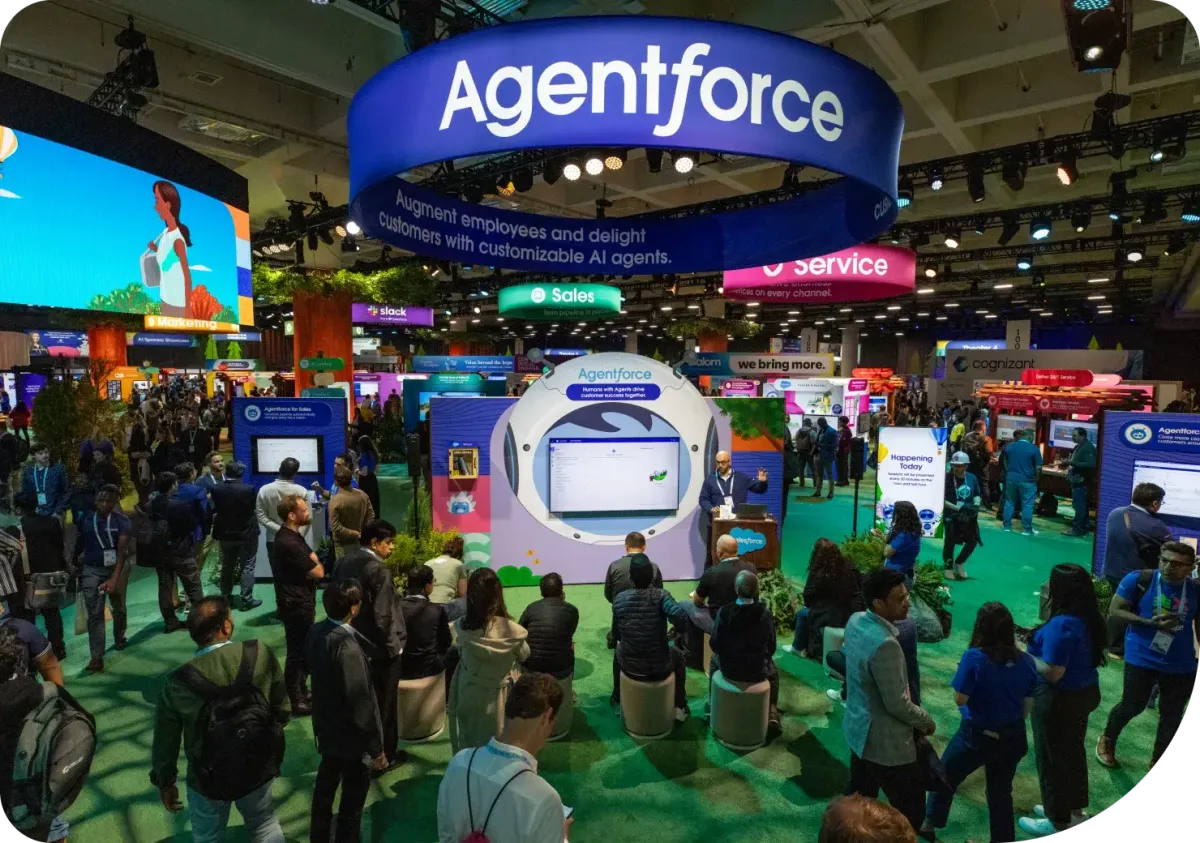
The company said the approach allows the model to learn business processes, workflows and operational policies rather than relying solely on generic language capabilities.
On Salesforce’s CRM benchmark, which includes real-world tasks such as updating sales opportunities, routing customer-service cases and scheduling follow-ups, the company said Koa matches or exceeds leading models on CRM actions while producing three times fewer errors.
“The most valuable thing Salesforce has built isn’t our platform — it’s the accumulated knowledge of how enterprise business actually works. With Koa, the knowledge is put inside the model itself. We trained a reasoning engine that understands the structure of a deal, the lifecycle of a service case, and the workflows that vary across industries. That’s a different kind of intelligence, and it runs entirely inside your trust boundary,” Marc Benioff, Salesforce Chair and CEO said.
Salesforce said no customer data was used to train Koa. Instead, its training corpus consists of synthetic scenarios designed to replicate the reasoning, tool use and decision-making required by Agentforce agents. The scenarios cover workflows across more than 14 industries, including manufacturing, financial services, healthcare and travel.
 The Left Shift Bureau
The model was post-trained using supervised fine-tuning and reinforcement learning, including Group Relative Policy Optimization (GRPO), with NVIDIA’s NeMo RL, NeMo Gym and NeMo AutoModel tools.
“AI is creating a much larger opportunity for software. Every company needs useful AI, tailored to its knowledge, expertise, and work. NVIDIA Nemotron open models give Salesforce the foundation to turn decades of enterprise expertise into specialized AI with Koa, creating a CRM model that can reason and securely take action,” Jensen Huang, NVIDIA Founder and CEO, said.
Salesforce said it controls Koa’s model weights and performs post-training and inference within its own infrastructure, keeping customer data inside its trust boundary.
The model is already being used internally, including through an agent in Slack, and is entering customer pilots with companies including 1-800Accountant, Baxter Credit Union, Engine, Formula 1, UChicago Medicine and Xero.
The companies are also extending Nemotron-based models and NVIDIA accelerated computing to Salesforce’s Missionforce, aimed at government and regulated organisations operating environments such as private clouds and air-gapped networks.
 The Left Shift Bureau
 Pritam Bordoloi