The 8 Biggest Announcements from Google I/O 2026
Google completely redesigned Search with AI at its core. Instead of typing keywords and scrolling through blue links, users can now interact with Search conversationally using text, images, files, videos and even Chrome tabs.

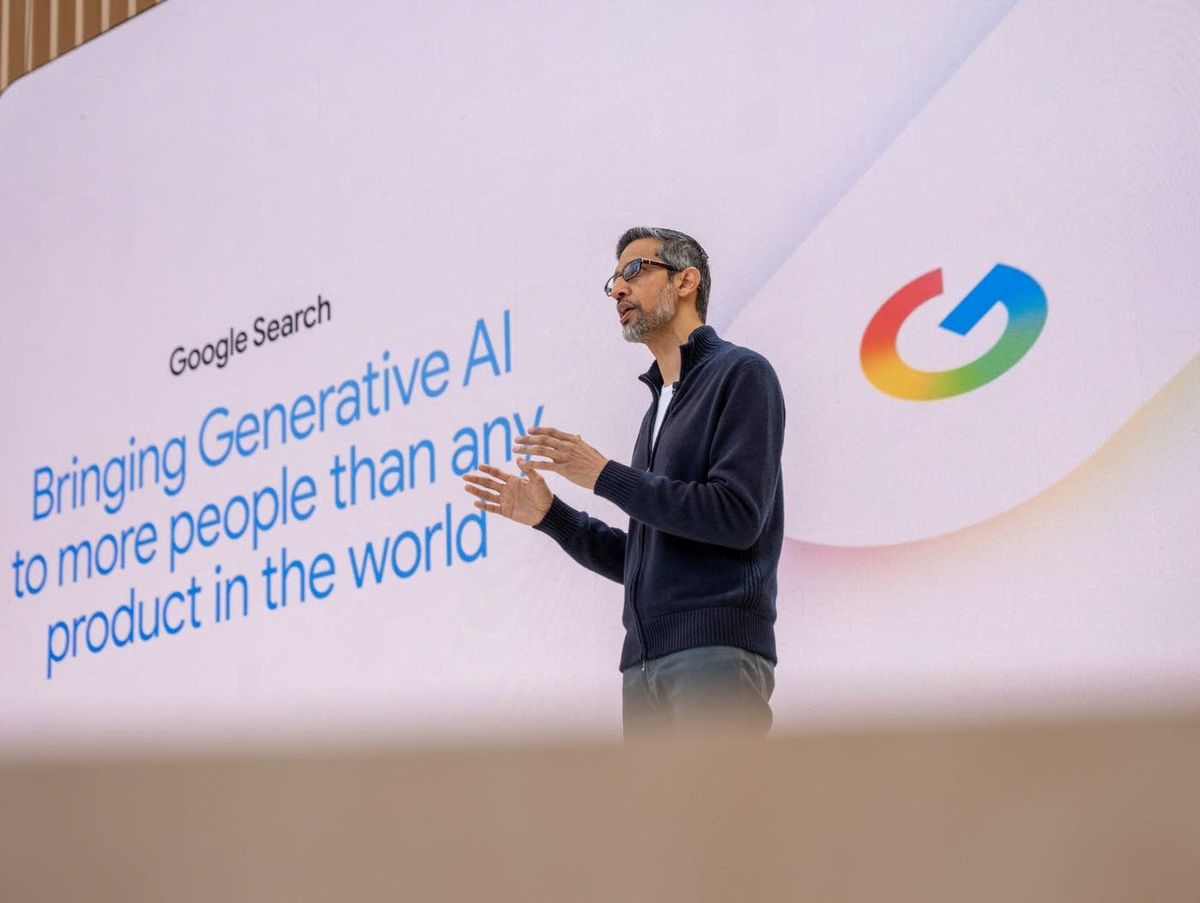
Google I/O 2026 was one of the company’s most ambitious developer conferences in years, with nearly every major announcement centered around AI agents, autonomous workflows and AI-powered interfaces.
CEO Sundar Pichai described the moment as the beginning of the “agentic Gemini era,” signaling Google’s shift from AI assistants that answer questions to AI systems that actively perform tasks.
Here are the eight biggest announcements from Google I/O 2026 and why they matter.
1. AI Search Gets the Biggest Upgrade in 25 Years
Google completely redesigned Search with AI at its core. Instead of typing keywords and scrolling through blue links, users can now interact with Search conversationally using text, images, files, videos and even Chrome tabs.
The new Search experience is powered by Gemini 3.5 Flash, which is now the default AI model in Search globally.
Google also introduced a brand-new intelligent Search box that dynamically expands as users type and uses AI to help formulate better questions. AI Overviews can now transition directly into full conversations with AI Mode while preserving context.
Perhaps the biggest shift is that Search is no longer just a discovery tool — it is becoming an execution platform. Google demonstrated Search generating interactive dashboards, visual simulations and mini apps in real time.
2. Search Agents Can Work for You 24/7
One of the most futuristic announcements at Google I/O 20206 was the launch of “Search agents,” which is an autonomous AI systems that continuously monitor the internet on behalf of users.
These agents can:
- Track apartment listings
- Monitor sneaker drops
- Follow sports news
- Watch stock prices
- Scan shopping deals
- Deliver personalized alerts
Google says these agents intelligently scan blogs, news sites, finance data, shopping feeds and social platforms to provide synthesised updates at the right moment.
The company also expanded “agentic booking,” allowing Search to compare prices and availability for experiences and services, and even call businesses directly for appointments like beauty bookings or pet care.
It is evident that Google is clearly trying to transform Search from a passive information engine into a proactive AI assistant.
3. Gemini 3.5 Flash Becomes Google’s New AI Backbone
Google officially launched Gemini 3.5 Flash, calling it its strongest AI model yet for coding, reasoning and agentic workflows.
The model is optimised for:
- Faster responses
- Autonomous task execution
- Coding assistance
- Long-horizon reasoning
- Multimodal understanding
According to Google Cloud benchmarks, Gemini 3.5 Flash outperformed earlier Gemini Pro models on coding and agent-based tasks while running at significantly lower cost.
"It’s our strongest agentic and coding model yet, outperforming Gemini 3.1 Pro on challenging coding and agentic benchmarks like Terminal-Bench 2.1 (76.2%), GDPval-AA (1656 Elo) and MCP Atlas (83.6%), and leading in multimodal understanding (84.2% on CharXiv Reasoning).
"When looking at output tokens per second, it is 4 times faster than other frontier models," Koray Kavukcuoglu, Google DeepMind CTO and Chief AI Architect; Jeff Dean, Google DeepMind and Google Research Chief Scientist; Oriol Vinyals, Google DeepMind VP, Research, and Noam Shazeer, Google DeepMind VP, Engineering, wrote in a blog post.
Google also confirmed Gemini 3.5 Flash will power Search, Gemini apps, enterprise tools and Antigravity.
4. Gemini Omni Pushes Google Into Full Multimodal AI
Google introduced Gemini Omni, its newest multimodal AI system capable of understanding and generating text, images, audio and video together.
"With Omni, you can combine images, audio, video and text as input and generate high-quality videos grounded in Gemini's real-world knowledge. You can also easily edit your videos through conversation," Kavukcuoglu added.
The first version, Gemini Omni Flash, focuses heavily on video creation and editing using natural language prompts.
Google demonstrated:
- AI-generated videos
- Conversational video editing
- Scene consistency across edits
- Audio-aware generation
- Image-to-video workflows
The company described Gemini Omni as a step toward “creating anything from any input.” Analysts immediately compared it to OpenAI’s Sora and other next-generation media AI systems.
5. Antigravity 2.0 Turns AI Into an Autonomous Software Engineer
Antigravity 2.0 may have been the most important developer-focused announcement of the event. Google upgraded Antigravity from an AI coding IDE into a full “agent-first” software engineering platform.
"Users interact with powerful agents both synchronously and asynchronously, and there is no IDE. While it retains many of the core principles of the Antigravity IDE’s Agent Manager surface, it is a completely separate desktop application," Google said.
New features include:
- Multi-agent orchestration
- Autonomous subagents
- Voice-controlled coding
- Scheduled background tasks
- Standalone desktop apps
- Command-line tools
- SDK support
Google claimed Antigravity used nearly 100 AI agents to build the framework of a working operating system in about 12 hours during an internal demo. The system reportedly generated missing drivers in real time to run Doom.
The platform directly competes with OpenAI Codex, Claude Code and Cursor.
6. Gemini Spark Introduces Always-On AI Agents
Google also launched Gemini Spark, an always-running AI assistant designed to proactively help users instead of waiting for prompts.
Spark operates continuously in the background and can:
- Organise schedules
- Monitor tasks
- Summarise emails
- Track expenses
- Coordinate workflows
- Interact with Workspace apps
"It’s deeply integrated with the Workspace tools you rely on daily, like Gmail, Docs, Slides and more. Even better, because it is a cloud-based agent, Spark keeps working in the background even when you close your laptop or lock your phone. That combination means Spark is ready to take complex tasks off your plate so you can be more present for what matters most," Josh Woodward, Google VP, Google Labs, Gemini app & AI Studio, said in a blog post.
Google says Gemini Spark is designed to act like a proactive AI assistant that can automate recurring tasks, learn custom workflows and manage complex projects.
Users can ask Spark to monitor monthly credit card statements for hidden subscriptions, track school updates from emails and generate daily summaries, or turn scattered meeting notes into polished Google Docs and draft project emails automatically.
Google is also expanding Spark’s capabilities through new MCP integrations with apps like Canva, OpenTable and Instacart.
In the coming weeks, Spark will gain additional features including texting and emailing support, custom sub-agents and the ability to operate a user’s local browser.
7. Android XR Smart Glasses Make a Comeback
Google officially returned to smart glasses with Android XR-powered wearable devices developed with brands like Warby Parker and Gentle Monster.
Unlike the original Google Glass, the new devices focus on:
- Lightweight design
- Audio-first AI interactions
- Navigation
- Live translation
- Contextual assistance
"There will be two types of intelligent eyewear: audio glasses that offer spoken help in your ear, and display glasses that show you the information you need, right when you need it. Both let you stay hands-free and heads up, and get you help from Gemini just by asking," Shahram Izadi, Google VP & GM, XR, said.
The glasses are deeply integrated with Gemini AI and represent Google’s attempt to compete in the growing AI wearable market alongside companies like Meta and Apple.
Google also previewed Project Aura and broader Android XR ecosystem updates.
8. AI Expands Across Gmail, YouTube and Workspace
Google announced deeper Gemini integration across nearly every major product in its ecosystem.
Some of the biggest updates include:
- “Ask YouTube” conversational video search
- AI-generated email summaries in Gmail
- Voice-powered interactions in Docs and Keep
- AI shopping features like Universal Cart
- Personalised AI using Gmail, Photos and Calendar data
"Ask YouTube entirely reimagines the experience, making information much more digestible and easy to navigate. You’ll see videos that best match your interest, and most importantly, it jumps right to the part of the video most relevant to you," Sundar Pichai said in his keynote address.
Google also redesigned the Gemini app with a new “Neural Expressive” interface featuring faster voice interactions and smoother transitions between text and live conversations.
The message from Google was clear: Gemini is no longer a standalone chatbot — it is becoming the AI layer powering the entire Google ecosystem.